How I learnt Norwegian on my own
Она делала большие списки-словари со словами и выражениями, которая она хотела выучить. Затем сочиняла истории используя эти слова и выражения, и посылала их своим друзьям для редактирования. После этого она многократно читала вслух эти истории до такой степени, что в конце концов она заучила их наизусть и могла их спокойно наизусть произносить. Это дало ей возможность свободно говорить и она утверждает даже что с хорошим акцентом.
************************************************************
Рекомендация уже не помню с какого Ютюба.
15 минут - вспомнить, крутить в голове.
15 минут - снова повторите + старое.
Следующий день повторять. Проговаривать каждое предложение. Повторение пройденного, задавать себе вопрос:
"Что я сейчас могу? Если не можешь, следовательно, плохо занимался.
«Метод 90 секунд» Антона Брежестовского
Простой способ учить английские слова быстрее и эффективнее
Как за 90 секунд выучить любое новое слово
Вкратце:
1. Записываем предложение, слово выделяем.
2. В течение 7 дней читаем вслух это предложение 1-2 раза.
3. Недельный перерыв
4. Через неделю читаем вслух три раза.
5. Через 2 недели снова читаем его вслух три раза в течение 10 секунд.
Метод “90 секунд”
1) Встретив новое слово, вы записываете его в словарь. В контексте. То есть записываете не “слово - перевод”, а целое предложение, в котором только что встретилось слово.А само новое словоподчеркивается или (если вы ведете электронный документ - как я, например) выделяется жирным шрифтом.
2) В течение семи дней (условно с 1 по 7 число) вы читаете вслух это выражение вслух один-два раза. Да-да, лишь один-два раза! Вы не стараетесь его запомнить, но концентрируетесь на нем и понимаете, что именно говорите (а не повторяете механически). На два прочтения уходит 10 секунд (проверено). Вы делаете это в течение семи дней.
2а) Таким образом, если за один урок вы прошли 15 новых фраз, то в последующие дни, тратя на каждую фразу по 10 секунд, вы будете тратить 150 секунд на повторение материала одного занятия.
3) После семи дней ежедневных повторов вы делаете недельный перерыв и через неделю (условно 14 числа) читаете новое выражение вслух еще три раза в течение 10 секунд. Да-да, лишь три раза, но вслух, эмоционально, четко и сконцентрировавшись на нем!
4) И еще через две недели (условно 1 числа следующего месяца) вы снова читате его вслух три раза в течение 10 секунд.
Итого: 90 секунд (70 + 10 + 10). При такой стратегии нужное предложение буквально “зацементируется” в вашей памяти. Все это проверено мной на собственном опыте.
Чтобы не было перенапряжения от избытка незнакомых фраз, словарный запас нужно пополнять постепенно: не каждый день, а примерно 3 раза в неделю.
Неизбежно будут и трудные слова. Если для них не хватит отведенного времени, придется применить тяжелую артиллерию: сфокусированно, четко и эмоционально повторить каждую фразу вслух 10–15 раз и делать это в течение 2–3 дней.
********************
Ведите учет повторений.
Чтобы знать, сколько раз вы уже повторили фразу, очень удобно вести табличку. В ней напротив каждой фразы вы ставите галочку, если эта фраза была вами повторена. Вот пример моей собственной работы по изучению слов (на примере итальянского языка):
http://yadi.sk/d/1XuZEQ7g6NdYC
Розовые графы - это первые семь дней повтора, а два желтые - это повторение через две недели и еще через две недели.
***
Два важных момента.
Хочу подробнее остановиться на двух важных моментах. Один - абсолютно обязательный, а второй - очень желательный.
Момент обязательный. Во время 10 секунд повтора необходима полная концентрация на новом выражении - то есть вы внятно, вслух произносите его и в голове ясно представляете, что оно значит.
Если во время повтора вы вдруг ловите себя на том, что повторяете механически, - ничего страшного. Просто приостановитесь и вернитесь к тому месту, с которого потеряли концентрацию. Да, новую фразу можно запомнить лишь за 90 секунд, но во время каждой их этих 90 секунд у вас должна быть полная концентрация на новом выражении.
Момент желательный. Говоря новое выражение вслух (вслух - это обязательно, помните?), представьте, что вы говорите его кому-нибудь. Джорджу Клуни, Карлсону, английской королеве - кому угодно. И скажите его эмоционально и с выражением. Эмоции - мощный катализатор в запоминании. Вы ведь даже спустя много лет до сих пор помните фразы, сказанные эмоционально, правда? Вот и воспользуйтесь этим приемом.
****************************************************************************
Дело в том, что наша память отличается одной интересной особенностью. Мы хорошо запоминаем информацию, с которой сталкиваемся примерно семь-девять раз в различных ситуациях. Подчеркиваю: не с усилием учим, а просто сталкиваемся. Но на которой фиксируем внимание полностью, а не вскользь. Такое количество раз нужно нейронам головного мозга, чтобы образовались достаточно прочные связи между ними. Если повторов меньше, нейронные связи получаются недостаточно крепкими, и мы забываем информацию.
Организовать точный учет повторений.
На уроке в словарный документ записывается десяток-полтора новых фраз.
На следующий день студент читает вслух этот листок. Помните? Не пытаясь выучить, а просто фиксируя внимание. Читает каждую фразу два-три раза. Больше не нужно - это все равно, что налить в растение слишком много воды. Но обязательно вслух.
После этого ручкой в Revision chart записывается дата такого повторения. А карандашом пишется дата следующего повторения. Это очень важный момент. Если не запланировать повторение сразу, то велика вероятность, что вы забросите свою Vocabulary Paper, не дойдя до заветной цифры 7-9 раз. Пожалуйста, помните: 4-5 повторов - практически бесполезно!
1) Записывать слова нужно только в контексте. Система “слово - перевод” по сравнению с системой “пишем фразу в контексте” - все равно, что старый калькулятор по сравнению с современным компьютером. Записывая слово в контексте, мы получаем массу ценных деталей (предлоги, артикли, порядок слов, и т.д.), а главное - при случае сможем сразу сказать готовую фразу в разговоре.
2) Весь словарь, который мы таким образом учим, неизбежно делится на три категории: фразы легкие, обычные и сложные. “Правило семи-девяти раз” работает для обычных слов. Иногда будут слова легкие (например, похожие на русские), для них хватит и 4-5 раз. Неизбежно будут и трудные слова. Если для них не хватит 7-9 раз, то нужно применить “тяжелую артиллерию”: сфокусированно, четко и эмоционально повторить каждую фразу вслух раз 10-15 и сделать это еще в два-три других дня.
3) Изученный словарь нужно использовать в живой речи! Это - один из главнейших секретов. If you don’t use it, you lose it. В следующей же беседе по-английски сознательно используйте именно новые слова, а не старый словарный запас. Иначе получится, что урожай помидоров вы соберете, но так их и не съедите. И, грустя от свой бесполезности, они просто-напросто сгниют...
Кстати, почему метод называется “90 секунд”? Потому что если правильно вести учет повторений, то на прочное запоминание каждой фразы уйдет примерно 90 секунд - 9 повторов по 10 секунд.
**************************************************
5 minutes a day method
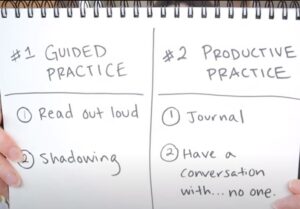
"Ready to get fluent in English? Let's commit to speaking every day, just 5 minutes a day! Hopefully, that 5 minutes turns into MORE minutes... But we'll be happy with being consistent, spending just 5 minutes a day speaking English! Remember that something is better than nothing."
The idea is to work at least 5 minutes a day, but in reality it will often be more.
Try to do what you want to do, not what you should or must do. Try to have fun.
Journal is writing about anything.
"Write something simple and read it out loud. I'm going to call this journaling or writing a journal entry, but it's not really journaling, so what you can do is take a question, how are you feeling right now, and you can just write about that, or think about a series that you're watching, think about a YouTube video that you're watching, think about a podcast that you're listening to, or maybe something that you shadowed in guided practice, and then react to that, give your opinion about the thing that you just saw, give your opinion in English. "
--------------------------------
1st experience (11/01/2025):
Read out loud: 14 min (around 3min of video)
Shadowing: 5 min (around 3min of video)
Journal: About 1.5 hours, including writing a post
Conversation with ChatGPT (12/01/2025): 29 min
Total: 2h 18m (!). (5 min vs 2h 18 min 🙂 )
Conversation - processing results: 36 min
Total Total: 2h 54 min, almost 3h
********************************************************************
I'm usually not good at inventing stories or speaking off the cuff, but today I think I found a fix. I watched a YouTube video by Vanessa and realized that even a short clip can be useful for a few minutes of speaking practice or a quick journal entry. I now know that I can take a short scene from a movie, YouTube video or TV show, describe what happens, and talk about it briefly. That's plenty for a short journal entry or a quick conversation with an AI partner.
********************************************************************
ChatGPT about how to learn deeply, not forget, and not burn out
All these questions came from me doing a small test in English. I supposed to spend on it 10-15 minutes, but in reality it took almost 1.5 hour. Now I have also somehow learn, absorb a new information. Do you have any idea how to do it effectively and quickly as possible?
Absolutely, Alex — this is a very common and important challenge:
"How do I absorb and retain new English knowledge from a test or study session, especially when it takes way longer than planned?"
Let’s break it down and create a practical, fast, and efficient post-study process to help you learn deeply, not forget, and not burn out.
✅ Your Situation
- You took a short test (meant for 15 min).
- You paused often, looked up rules (like adjective order, reduced clauses, etc.).
- It turned into a deep dive — 1.5 hours.
- Now your brain is tired, but you want to keep what you learned.
This is great — it means you’re working at a C1-level mindset, seeking understanding, not just answers. But now you need a recovery + learning strategy.
🎯 Goal: Learn More Efficiently After Deep Study
Here’s a simple 3-step system you can follow every time.
✍️ STEP 1. Summarize in Your Own Words (2–5 min)
Write short notes — by hand or typing — answering:
- What confused me at first?
- What do I know now?
- What’s one clear example I remember?
✅ Why this works: It moves info from short-term memory to long-term by processing it actively, not passively.
🎧 STEP 2. Use It Actively (5–10 min)
Instead of memorizing grammar rules, use the new structure:
- Write 1–3 your own sentences using it (I can check them for you — CW2)
- Or create a mini-dialogue or short paragraph using that structure
- Or do shadowing with an example sentence that contains the structure
✅ Example: Just learned “First to arrive…”?
Write:
First to arrive at the café, I grabbed the best seat near the window.
🎯 You don’t need to do 20 examples — just 2–3 that feel meaningful to you.
🔁 STEP 3. Quick Review the Next Day (2–3 min)
Don’t let it fade.
The next day:
- Glance at your notes or saved example sentences
- Try to say one sentence out loud from memory
Even a 1–2 minute micro-review the next day will double your retention.
⏱️ Optional: 10-Minute Review Template
Here's a compact version you can use after any deep study:
| Time | Action |
| 2 min | Write down the 1–2 key points you learned (in your own words) |
| 5 min | Write or speak 2–3 new sentences using the rule |
| 3 min (next day) | Review examples or try to recall one from memory |
🧠 Bonus Tips
- Use ChatGPT as your review partner — just say: “Here’s what I learned. Can you quiz me tomorrow?”
- Speak out loud — the brain remembers spoken language better than silent reading.
- Don’t aim for perfection — aim for repetition and variety. The more you use a structure in different situations, the faster it sticks.
*******************************************
Feynman's SECRET to Learn ANY Language 27X FASTER
Feynman's SECRET to Learn ANY Language 27X FASTER
It seems that these ‘secrets’ aren’t actually Feynman’s methods. Feynman was a physicist, and the material in those videos feels like it might even be AI-generated. It’s likely that someone either loosely borrowed his ideas and applied them to language learning or just used his name to make the content sound more convincing. That said, some of the tips actually seem pretty useful. (My note)
... The secret isn't in repeating words mechanically or memorizing endless lists. The secret lies in how you direct your mind. When all you do is read, listen, or try to memorize, your brain can trick you. It doesn't push itself.
It prefers to spend as little energy as possible convincing you that you've understood when in reality you haven't.
That's where so many people go wrong.
But when you try to explain something, there's no way to hide from the truth.
If you don't truly understand it, you'll stumble. And that stumbling is pure gold. That's the moment your mind shows you exactly where the gaps are. Never settle for memorization alone. Aim to understand. And once you understand, explain it. That's the key almost no one applies. And yet it can multiply the speed of your learning by 27 times.
Because the moment you try to explain something out loud, something extraordinary happens in your brain. The connections that were once scattered begin to organize. The simple act of teaching forces your mind to create order out of chaos. It's as if you had pieces of a puzzle scattered across a table and suddenly you're compelled to fit them together so the picture finally makes sense. That's why you should always explain what you just learned.
Even if you haven't mastered it yet, teach it to yourself out loud. Repeat it as if you were giving a class. And if there's someone nearby, dare to explain it to them, too. Don't worry if it feels strange because it's in that effort to organize ideas that your mind locks in the knowledge. Don't be afraid of sounding silly. Don't worry if your explanation comes out incomplete, awkward, or full of holes. The very act of turning thought into words makes your brain work on a different level. And in trying to explain it correctly, your brain automatically pushes itself to learn. That's when you leave the passive mode and step into active learning. And active learning is what separates the people who spend years struggling from the ones who learn in a matter of months. Each time you explain, even to yourself in the mirror, you're reinforcing confidence. You're telling your mind, "I can master this." And that self-confidence is fuel. It pushes you to keep going, not to quit, to review until everything is crystal clear. So engrave this law deep inside you. Those who explain learn. Those who teach retain. Those who organize what they know achieve mastery.
... Concentration. Concentration is everything. Many people study for hours and convince themselves they're making progress, but in reality, they're just wasting time. Studying for hours without focus is wasteful. But 30 minutes of absolute attention, that's pure fire. Here's the key. Use short, focused study sessions with precise breaks. Structure your learning into blocks. For example, if today you want to study for 2 hours, divide it into four sessions of 30 minutes each with a 10-minute break between them. But during each of those 30 minutes, cut off every distraction. Silence your phone, close the tabs, and give your full attention to that moment. Every second you allow yourself to be interrupted is a piece of energy stolen from your dream. Focus and you'll multiply the value of every minute tenfold. And here's another secret. It's not about studying more, it's about studying better. Organize your priorities. If you only have one hour a day, don't waste it on irrelevant details. Always ask yourself, what's the single most important thing that will push me forward right now? That answer becomes your compass. ... Concentration is not a gift only a few people are born with. It's a muscle.
The more you train it, the stronger it gets. At first, maybe you'll manage only 5 minutes of real focus, then 10, 20, 40. Eventually, you'll reach a point where immersing yourself in the new language feels so natural that you forget the world around you. That is the state where learning explodes, where every minute is worth hours. And no matter your age, your brain is always learning. That's why the very first commandment is this. How should you learn? Never by memorizing. Most people fail because they try to stack words in their head as if the mind were just a storage box. But the brain wasn't designed to memorize. It was designed to connect, to visualize, to create meaning. That's why every time you learn a new word, don't translate it. When you learn a new word, picture the image of the object itself. If you learn the word coachce in Spanish, don't think of the English translation. See the image of a car. Watch the wheels turning. Feel the engine. Imagine yourself driving down the road. That scene ties the word directly to experience, to the real world, without passing through the barrier of translation. In this way, your mind begins to understand the language the same way a child understands the world naturally, vividly, without intermediaries. Now, apply this to everything you learn.
Bring the language into your reality.
Turn words into experiences and experiences into memory. The closer the scene you create is to something real, the faster your brain locks it in. So never forget, you can learn any language 27 times faster. No matter your age, no matter how difficult it seems, all you need to do is abandon the old crutch of translation and embrace the power of images, experiences, and explanation.
That's how you you unlock the potential that has always been inside you. Now understand this. The secret isn't to study for hours and hours without stopping. The brain doesn't learn that way. What really works is to divide your study time into 30 minute blocks of total focus followed by 10 minutes of rest. In those 30 minutes, shut everything else off and immerse yourself in the language as if nothing else exists.
Learn How to Absorb a New Language in Minutes — Feynman’s Genius Method
Learn How to Absorb a New Language in Minutes — Feynman’s Genius Method
The real transformation happens when you try to explain what you've learned out loud.
By speaking out loud, you're not just reviewing information. You're actively reconstructing it, building neural highways that solidify your understanding. This simple practice can multiply your retention by up to 27 times compared to passive methods.
But there's another critical element that impacts everything. The quality of your concentration. Instead of long distracted sessions, break your study time into 30 minute blocks of complete immersion followed by 10-minute breaks. During these concentrated blocks, eliminate every possible distraction and give your undivided attention to the language.
Evolution crafted our brains to connect, visualize, and create meaning through sensory rich experiences. This insight completely transforms the language learning journey. When you come across the Spanish word manzana, the conventional approach tells you to memorize mansana bark apple and repeat it until it sticks. But this method fights against your brain's natural architecture. Instead, picture a vibrant red apple. Imagine its weight in your hand. Visualize biting into its crisp flesh and taste that perfect balance of sweetness and tartness. Feel the juice running down your chin. Smell its fresh aroma. By creating this multisensory experience, you're engaging neural networks that are vastly more powerful than those used for wrote memorization.
Fineman method combines three powerful techniques into one cohesive system.
- Structure your learning into short, intensely focused blocks of 30 minutes followed by 10-minute breaks. During these sessions, eliminate all distractions and immerse yourself completely in the language as if nothing else exists.
- Always connect words directly to vivid images and sensations rather than translations.
Create rich multi-sensory experiences for each new concept you encounter. - Solidify your understanding by explaining what you've learned out loud, either to yourself or to someone else.
*********************************************************************************
Feynman’s 10-Second Genius Trick...
... The most effective language learners commit to creating just 15 new sentences every day using their newly acquired vocabulary. The key revelation here is that these aren't random examples from a textbook, their sentences relevant to your life, your work, your interests, your actual reality. This is where your language journey becomes deeply personal and therefore unforgettable. ...
Knowledge isn't real until you use it. ... Every time you force your brain to actively recall a word, instead of merely recognizing it, you strengthen the neural pathways associated with that word, making it more accessible when you need it in real conversation.
***************************************************
ChatGPT:
🎯 Efficient English Learning with Subtitled TV Series
(20-minute daily method)
💡 Goal
Improve listening, vocabulary, fluency, and pronunciation through short, focused practice using real TV dialogues — without spending hours on a full episode.
🪜 Step-by-Step Instructions
1️⃣ Choose a short clip (2–3 minutes)
-
Select a scene with clear conversation and natural speech (not action scenes).
-
Pick only one or two clips per episode — quality is more important than quantity.
-
Optional: use Language Reactor or another tool for subtitles and quick translations.
2️⃣ First Watch — Get the idea (≈5 min)
-
Watch once with English subtitles.
-
Don’t pause for every word; just follow the story.
-
Mark 3–5 useful or interesting expressions (not every new word).
3️⃣ Vocabulary Focus — Learn key phrases (≈5 min)
-
Look up the meanings of those 3–5 phrases.
-
Write short notes and create one original sentence for each phrase.
-
Focus on how native speakers use them in context.
4️⃣ Shadowing Practice — Improve speech (≈5 min)
-
Play the same scene again, pausing line by line.
-
Repeat after the actors — copy their pronunciation, intonation, rhythm, and emotion.
-
Use 0.75× speed if needed.
-
Record yourself occasionally to check your pronunciation progress.
5️⃣ Rewatch Without Subtitles — Check comprehension (≈5 min)
-
Watch again without subtitles.
-
Aim to understand 70–80% of what’s said.
-
If something still feels unclear, note it for later review.
6️⃣ Optional Bonus — Speak or write a summary (2–3 min)
-
Describe the scene aloud or in writing using what you learned.
Example: “In this scene, Midge tries to talk to Joel, but he avoids her. She sounds calm, but you can tell she’s hurt.”
-
This helps transfer passive knowledge into active English.
First try: 35 min for 30sec clip + 15min speaking and discussing my accent with Hume
Как быстро учиться. Немецкий с А2 до С2 за год
https://www.youtube.com/watch?v=KhdwyoJcBB0
✅ Краткое резюме видео (по-русски)
Автор рассказывает, как она выучила немецкий язык с уровня А2 до C2 примерно за год и затем успешно училась на юридическом факультете.
Главный секрет — метод концентрированного изучения + активного припоминания (recall method).
🎯 ОПИСАНИЕ ОСНОВНОГО МЕТОДА («Метод припоминания»)
1. Учёба короткими, жёсткими интервалами (15 минут)
-
Ставить таймер на 15 минут.
-
Смотреть видео / проходить урок очень концентрированно, без отвлечений.
*2. После 15 минут — всё закрыть и ничего не смотреть
-
Закрыть видео, ноутбук, тетрадь — никаких подсказок.
-
В голове воспроизвести:
-
что понял/а,
-
какие слова выучил/а,
-
какие идеи можешь объяснить сейчас.
-
3. Задать себе ключевой вопрос:
👉 «Что я сейчас могу?»
Если ответ — «ничего» или «я просто посмотрел(а) видео», значит, занятие было неэффективным.
4. Вторая 15-минутка
-
Новый отрезок учёбы.
-
Затем снова закрыть всё и:
-
повторить материал второй части,
-
повторить материал первой части.
-
5. На следующий день — полное повторение
Утром повторить весь материал вчерашнего дня, также без подсказок.
Потом снова учиться интервалами, каждый раз повторяя новое вместе со старым.
6. Концентрированное выполнение упражнений
-
Проговаривать вслух каждое предложение.
-
Постоянно возвращаться к пройденному материалу.
-
Работать медленно, осознанно, с вниманием.
🗂️ Как работать со словами
Автор использует два приёма:
A. Карточки + персонализированные предложения
-
На карточке — слово + реальное предложение из твоей жизни.
-
Затем визуализация ситуации, где ты это предложение произносишь.
-
Мозг запоминает лучше, потому что связывает слово с конкретным действием.
B. Вечернее припоминание
-
Ложась спать, без карточек попытаться вспомнить все слова дня.
-
Очень эффективно для закрепления.
C. Встречать слова позже в текстах
-
Настоящее запоминание происходит, когда слово снова встречается в контексте.
-
Поэтому автор включает новые слова в тексты уроков, чтобы ученики снова на них наталкивались.
🧠 Почему метод такой эффективный
-
Работа идёт не «по бумаге», а с собственным мозгом.
-
Активное припоминание усиливает память в разы.
-
Комбинация интервалов + повторений создаёт «ступеньки» быстрого прогресса.
-
Метод использовали студенты юридического факультета в Германии — и видели лучшие результаты.
🧩 Краткая формула метода
15 минут учёбы → закрыть всё → рассказать себе что понял → спросить «Что я сейчас могу?» → следующая 15-минутка → повторить старое + новое → на следующий день повторить всё.
***********************************************
Do you think this method is good?
✅ Short answer:
Yes — this method is very effective, because it is built on two scientifically powerful principles:
-
Active recall (активное припоминание)
-
Spaced repetition (интервальное повторение)
These are the two strongest known techniques in cognitive science for long-term learning.
But the method also has limits that you should understand.
⭐ Why this method works extremely well
1. It forces your brain to retrieve, not just recognize
Simply watching or reading material creates an illusion of learning.
But asking yourself:
👉 “What can I say right now?”
forces the brain to produce the language — and this is what creates strong memory traces.
This is the same idea behind:
-
flashcards with recall
-
the Feynman technique
-
teaching something to someone else
-
shadowing summaries
For language learners, this is pure gold.
⚠️ Weak points of the method (honest critique)
1. It builds memory, but not full fluency by itself
You must also practice:
-
speaking aloud
-
shadowing
-
interacting with another speaker
-
pronunciation work
Otherwise your passive knowledge will grow faster than your active speaking skills.
2. It works best with structured materials
The method is weaker if:
-
the video content is chaotic
-
the material is too easy
-
the video is too difficult (no comprehension to recall)
It requires input at the right level (i+1).
3. It may become tiring without variation
Doing only this method can feel repetitive.
For best results, mix it with other techniques:
-
shadowing
-
reading aloud
-
controlled speaking practice
-
grammar drills when needed
4. Requires honesty with yourself
The key question:
👉 “What can I say right now?”
is psychologically uncomfortable.
You must admit when the answer is “nothing.”
Some learners avoid this, and then the method loses its power.
🧠 My professional conclusion (as your tutor):
✔️ The method is excellent for memory, comprehension, and turning passive input into active knowledge.
✔️ It is VERY suitable for you, because you already like structured, analytical learning.
✔️ You will progress faster if you combine this with your speaking/shadowing practice and your C1 writing practice.
If you use this method with:
-
your TV series dialogues
-
daily ESL videos
-
your Study & Learn lessons
-
grammar topics
you will absolutely see improvement.
****************************************
****************************************
✅ First: You do NOT need a traditional structured course to use this method effectively
This is important:
👉 The method works even without a structured course,
but you must create your own “mini-structure”.
*********************************************
Как учить английские слова без зубрёжки и стресса (Веня)
Как учить английские слова без зубрёжки и стресса (метод, который реально работает)
Summary by ChatGPT:
✅ 1. Stop Memorizing Word Lists — Learn Chunks Instead
Don’t learn single words. Learn ready-made phrases.
❌ Bad:
-
book = книга
-
put = класть
✅ Good:
-
put down the book
-
I couldn’t put that book down
Why it works:
Your brain remembers rhythm, context, and emotion, not isolated words. Each phrase becomes a reusable “building block” you can steal and adapt in real life.
What to do daily:
-
Memorize 3–5 full phrases, not single words
-
Change only one part:
-
put down the phone, put down the bag, etc.
-
✅ 2. Train Your “Speech Muscles” with Active Watching
Don’t just watch — copy and act out.
How to do it:
-
Pick a 30–60 second scene
-
Pause after each line
-
Repeat it out loud, copying:
-
Intonation
-
Speed
-
Emotion
-
Body movement
-
-
Use the phrases during the day (even jokingly)
✅ After 5–7 repetitions, your body remembers the phrase automatically.
✅ 3. Voice Everything You See (Daily Inner Monologue in English)
Describe your life in English as you go.
Examples:
-
I’m making coffee.
-
I’m looking for my keys.
-
It’s getting dark.
✅ After 1 week, your inner voice switches to English
✅ You stop translating
✅ You start thinking directly in English
✅ 4. The 24-Hour Rule: Use It or Lose It
If you don’t use a new word within 24 hours — it dies.
Right after learning a word, do at least one of these:
-
Say a sentence out loud
-
Text a friend
-
Record yourself
-
Create a mini-dialogue
🧠 Rule to remember:
If a word didn’t leave your mouth, it doesn’t exist.
✅ 5. Use Emotional Anchors (Emotion = Memory Super Glue)
Attach every word to your real life.
Example:
-
You feel exhausted → say:
-
I’m exhausted.
-
I was exhausted yesterday.
-
Don’t imagine a textbook situation — remember your own life.
Emotion locks the word into long-term memory.
✅ 6. Activate Words During Sleep (Sleep Rehearsal)
Before sleeping:
-
Play 5 minutes of English audio
-
Use the same words you studied during the day
🧠 While you sleep, your brain:
-
Strengthens neural connections
-
Repeats for you automatically
-
Sometimes even produces English dreams (yes, really)
✅ 7. The “Spy Method” (Shadowing with Delay)
Repeat what you hear with a 0.5–1 second delay.
This activates:
-
Hearing
-
Speech muscles
-
Stress memory (which boosts retention)
✅ After several sessions:
-
Your accent improves
-
Your speech becomes more natural
-
You stop consciously memorizing — you start copying automatically
🧠 The Core Philosophy (Most Important Idea)
❌ Don’t “learn” a language
✅ Live inside the language
Every word should become a mini life experience, not a dictionary entry.
Your brain is designed to learn through:
-
Emotion
-
Repetition
-
Real situations
-
Movement
-
Voice
-
Meaning
Not through lists and columns.
✅ Your Ideal Daily Mini-System (10–20 Minutes)
Here’s a simple version based on the video:
-
Learn 3–5 useful phrases
-
Say them out loud with emotion
-
Use them in self-talk during the day
-
Act out one short scene
-
Repeat the same words quietly before sleep
******************************************
Я выучил английский до уровня носителя (вот что я делал каждый день) (Веня)
Ежедневно:
1. Английский первым делом — с утра слушать что-нибудь на английском.
Цель — пробудить ухо на английском.
2. Мини—письмо на английском (5-10 мин утром).
3. Английский в движении днем: Слушать речь, фразы на английском.
4. Внутренний дубляж — говорить себе что происходит на английском.
5. Разговарная активация вечером — говорить себе 10 минут, что произошло за день. Можно записывать свой голос на аудио. Главное — говорить, не думая о грамматике.
6. Английский перед сном — аудио или видеосериал на английском 5 мин.
✓Главное —постоянство в изучении языка.